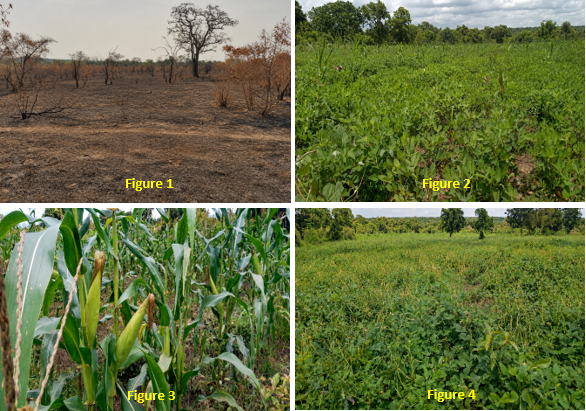


There was a time when this landscape offered little indication of the productive potential it held. Degraded vegetation, declining land quality and limited livelihood opportunities meant that the land was contributing far less to the wellbeing of surrounding communities than it could.
Today, that narrative is beginning to change.
Through Afrivoices for Climate Change, previously degraded land (figure 1) has been brought back into productive use, creating space for women farmers to cultivate crops such as groundnuts (Arachis hypogaea) [figure 2], maize (Zea mays) [figure 3]and beans (Phaseolus vulgaris) [figure 4]. The significance of this transformation is not simply that crops are growing again. It is that women are increasingly gaining access to productive resources through which they can produce food, earn income and make decisions about their own livelihoods.
We approached the landscape with the understanding that environmental restoration has greater meaning when communities can see tangible benefits from it. Rather than separating land restoration from livelihood development, the intervention sought to connect the two. This approach is consistent with current international thinking on sustainable land management. The United Nations Convention to Combat Desertification (UNCCD) and FAO emphasize that land restoration is more likely to deliver lasting results when people have secure and meaningful access to land and can derive livelihoods from sustainable land-use practices (UNCCD & FAO, 2024). Therefore, bringing the above land (figure 1) back into production represents more than an environmental achievement. It provides an opportunity to turn an underused resource into a productive household and community asset.
Women at the Centre of the Transformation
One key lesson from the experience has been the importance of positioning women as participants and producers rather than simply as beneficiaries. Women are cultivating the land, making production decisions, sharing knowledge within their groups and gradually developing the confidence to take greater responsibility for their economic futures.
This matters because women continue to face significant disadvantages in agrifood systems. FAO's Status of Women in Agrifood Systems shows that unequal access to land, finance, technology, information and other productive resources continues to limit women's agricultural productivity and economic opportunities. FAO also concludes that greater gender equality in agrifood systems can strengthen household welfare, productivity, incomes and resilience (FAO, 2023).
Climate change makes these inequalities even more important to address. FAO’s 2024 The Unjust Climate report highlights that rural female-headed households in low- and middle-income countries suffer disproportionately greater income losses from heat stress and flooding than male-headed households (FAO, 2024). Recognizing this unequal burden of climate change, Afrivoices for Climate Change places women’s resilience at the centre of its interventions by strengthening their productive capacities, expanding livelihood opportunities, and enhancing their economic agency to better withstand and recover from climate-related shocks.
Growing Food That Matters
The crops being cultivated also tell an important part of the story.
Groundnuts, beans and maize are familiar crops within rural farming systems, but together they can contribute to both household food supply and marketable production. Beans and other pulses provide important plant-based sources of protein and micronutrients, while maize remains an important staple and source of dietary energy.
The FAO and World Health Organization's 2024 joint statement on healthy diets emphasizes dietary diversity and identifies whole grains, pulses, nuts and other nutrient-dense foods as important components of healthy diets.
The transformation therefore has a nutrition dimension as well as an economic one: productive land can contribute to food availability, household dietary diversity and income generation.
The green landscape visible today should therefore not be viewed as the end of the intervention. It is the foundation for what can come next.
Future investment could help women farmers and even youth move beyond current production through access to improved seed, climate information, small-scale irrigation, appropriate mechanization, post-harvest technologies, storage, value addition and stronger market connections.
The opportunity lies in developing a model that transforms degraded land into productive, year-round landscapes that generate food and income, while empowering women with greater access to and control over productive assets, making them key drivers of household and community resilience.
Our experience is still unfolding, but the progress already offers a powerful lesson: when communities are meaningfully engaged in restoring the landscapes they depend on, and women are empowered to take productive ownership of that transformation, land restoration becomes more than an environmental intervention. It becomes a pathway to stronger livelihoods, greater economic agency, and more resilient households and communities.
References
FAO. (2023). The Status of Women in Agrifood Systems. Food and Agriculture Organization of the United Nations.
FAO. (2024). The Unjust Climate: Measuring the Impacts of Climate Change on Rural Poor, Women and Youth. Food and Agriculture Organization of the United Nations.
FAO & WHO. (2024). What Are Healthy Diets? Joint Statement by the Food and Agriculture Organization of the United Nations and the World Health Organization.
UNCCD & FAO. (2024). Securing Tenure to Restore Land and Safeguard Livelihoods. United Nations Convention to Combat Desertification and Food and Agriculture Organization.